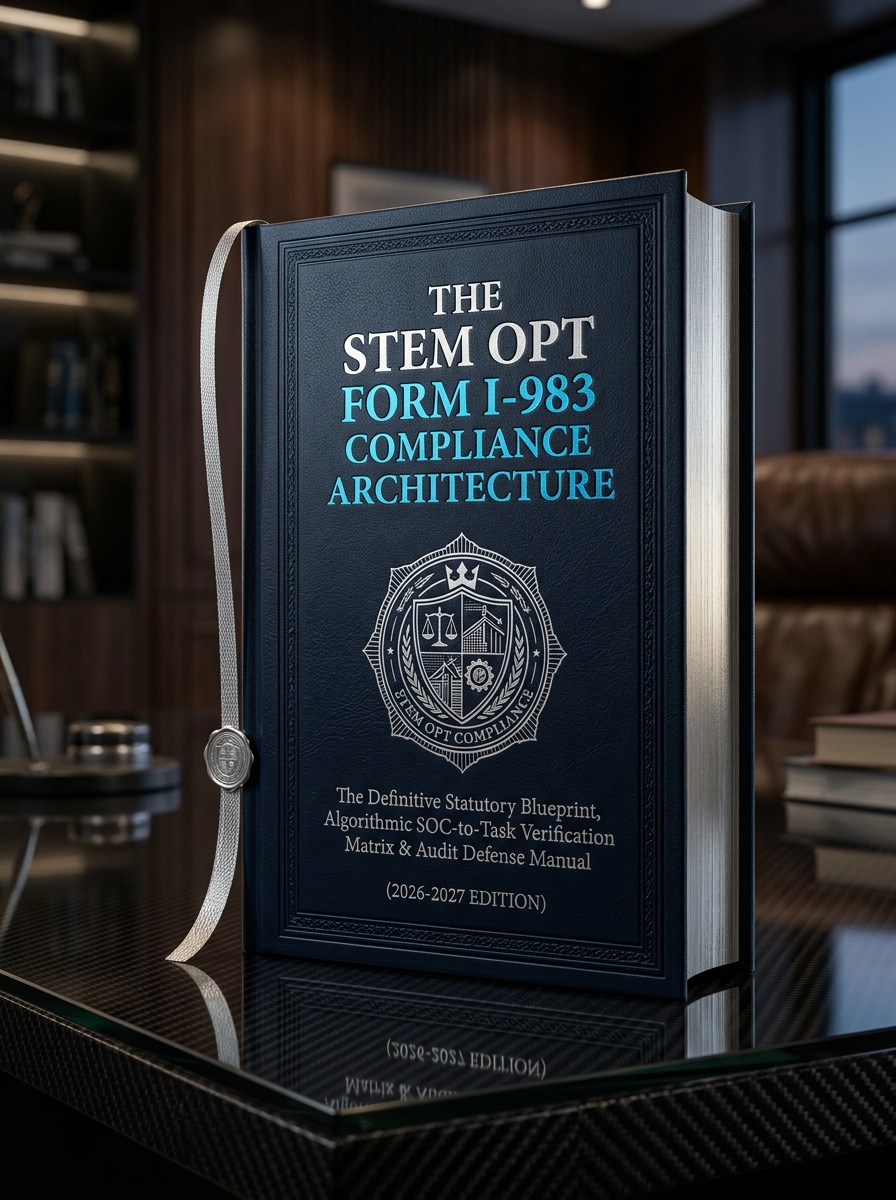
For international software engineers, machine learning specialists, and early tech hires on an F-1 visa, the 24-month STEM OPT extension is not HR routine—it is a $385,000 gross wage preservation asset. A single vague clause triggers an automated USCIS Request for Evidence, freezing legal work authorization.
Real-time heuristic evaluation simulating USCIS automated natural language processing (NLP) intake filters and Department of Labor Standard Occupational Classification (SOC) taxonomies.
Load a preset or enter Section 5 text, then click "Execute Statutory NLP Audit".
Every subsection of Form I-983 Section 5 must satisfy strict Department of Homeland Security natural language processing tests. Copy vetted statutory clauses directly into your draft.
The Trainee functions as an Associate Distributed Systems Engineer specializing in backend infrastructure. The Trainee applies formal computer science principles—including concurrency control, relational database normalization, and algorithmic complexity analysis—to design, implement, and benchmark fault-tolerant microservices. Daily engineering tasks include developing asynchronous REST and gRPC application programming interfaces (APIs) in Go and Python, architecting database migrations using PostgreSQL, implementing caching layers using Redis, and maintaining automated CI/CD pipelines via GitHub Actions.
Calculate remaining DSO review lead time and financial wage exposure.
Built to rigorous W3C CSS Paged Media standards. Five dedicated chapters eliminating every statutory failure vector.
Exact mathematical modeling of the $385,000 wage asset. The 180-day automatic employment authorization bridge under 8 CFR § 274a.12(b)(6)(iv), and timeline traps between initial OPT lapse and EAD delivery.
Forensic analysis of automated semantic screening deployed by adjudicators. The 10 high-risk vague or non-specific phrases ("spearhead", "synergies", "delve") that trigger manual scrutiny and officer RFEs.
Exhaustive deconstruction of 8 CFR § 214.2(f)(10)(ii)(C): (1) Direct Relationship Prong, (2) Commensurate Opportunity Prong, (3) Structured Supervision Prong, and (4) Objective Evaluation Prong.
Complete turnkey Section 5 matrices mapped to DoL O*NET codes: Software Developers (15-1252), ML/AI Engineers (15-2051.01), Data Scientists (15-2051), Systems Architects (15-1211), DevOps/SRE (15-1244), and AppSec (15-1212).
A 2-page legal memorandum for non-lawyer startup founders and HR directors. Defeats fears of prevailing wage audits, explains safe-harbor worker protections, and includes SEVP site inspection readiness checklists.
Included in the Complete Defense Suite: the standalone stem_opt_verifier.py command-line auditor for air-gapped terminal validation, JSON CI/CD reports, and local employer compliance auditing.
A single billable hour with an immigration attorney costs $450 to $750. Protect your $14,000/month wage asset with battle-tested engineering architecture.
Designed for individual international software engineers, data scientists, and early tech hires preparing their Form I-983 submission.
For engineers, non-lawyer startup founders, and engineering managers requiring both algorithmic verification and executive signing defense.
stem_opt_verifier.py Python CLI source code.
Clear, plain-English statutory answers on Form I-983 compliance under 8 CFR § 214.2(f)(10)(ii)(C).
Under federal regulation 8 CFR § 214.2(f)(10)(ii)(C), Designated School Officials (DSOs) are personally liable under SEVP certification if they endorse a Form I-20 with an insufficient Form I-983. Most rejections are triggered by: (1) subjective platitudes lacking quantitative metrics, (2) failure to establish a direct nexus between the student's CIP code and specific engineering duties, or (3) generic AI-generated buzzwords that signal a lack of genuine employer training oversight.
Non-lawyer founders often confuse Form I-983 with an H-1B Labor Condition Application (LCA) and fear triggering Department of Labor wage audits. Our Founder Safe-Harbor Memorandum (included in Chapter 5 and the Complete Defense Suite) provides a clean 2-page legal explanation demonstrating that Form I-983 is a student training plan, does not require a formal prevailing wage determination, and contains standard safe-harbor certifications that safeguard company IP and normal management practices.
No. Form I-983 is not an academic examination or university essay; it is a federal compliance document. Our verification engine functions like an automated linter (similar to static code analysis or grammar linters), verifying that your draft includes mandatory statutory components and complies with Department of Labor Standard Occupational Classification (SOC) taxonomies.
Yes. Following the conclusion of COVID-19 emergency flexibilities, SEVP issued formal policy guidance confirming that STEM OPT trainees may engage in remote or telework employment, provided that: (1) the employer maintains direct electronic supervision (e.g. daily standups, GitHub pull request reviews, video 1-on-1s), (2) the training objectives remain fully structured, and (3) the trainee's remote work site is accurately disclosed on Form I-983 Section 3 and Section 5.
Under 8 CFR § 274a.12(b)(6)(iv), an F-1 STEM OPT student who timely files Form I-765 prior to the expiration of their initial 12-month post-completion OPT EAD receives an automatic 180-day extension of work authorization while USCIS adjudicates the petition. However, this bridge is entirely contingent upon timely filing—which requires obtaining an updated Form I-20 from your DSO with the STEM recommendation before your current card expires.
Every university has slight procedural variations in DSO review workflows. If your DSO requests any changes, our Complete Defense Suite includes priority redline assistance. Furthermore, we provide a 100% 30-day money-back guarantee if you are not completely satisfied with the architectural dossier.